Leave A Message
If you are interested in our products and want to know more details,please leave a message here,we will reply you as soon as we can.

When WHP Global and G-III Apparel closed a $925 million deal for Marc Jacobs, it was more than another fashion headline. It confirmed something the bag trade has known for years: the handbag and fashion-accessories category remains one of the most active corners of brand licensing, M&A, and creative turnover. But for overseas wholesalers, brand owners, and importers, the real story sits one layer deeper. Behind every licensed label is a network of OEM/ODM factories that turn brand equity into physical, shippable product.
The Marc Jacobs transaction is not an isolated event. Look at the broader landscape and the pattern repeats:
Across all three, the same structure holds. Capital and creative directors rotate frequently — but production stays anchored to specialist manufacturers who understand materials, compliance, and scale. That division of labor is not a weakness of the model. It is the model.
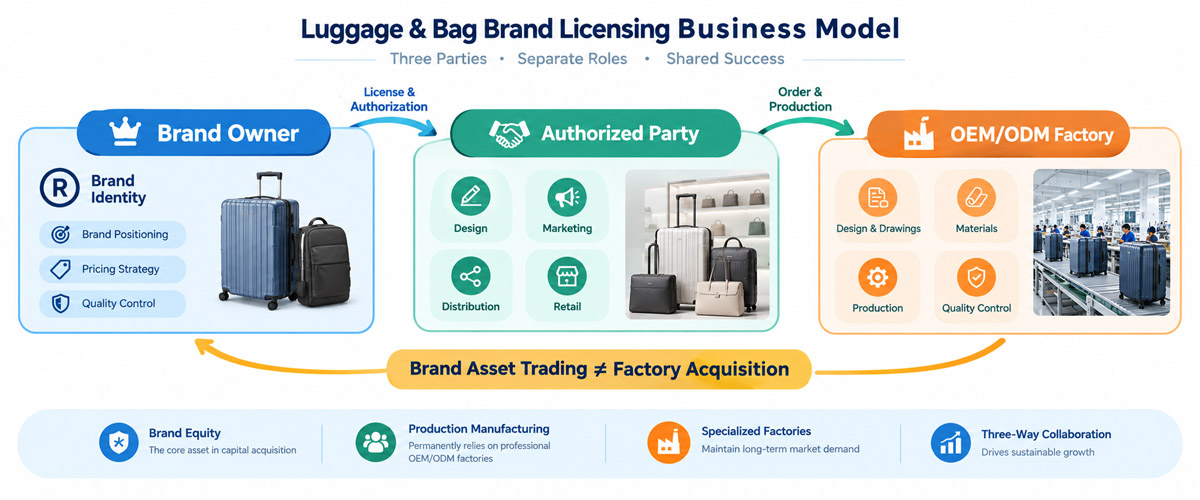
At its core, a brand licensing deal separates three jobs:
1. The brand owner owns the trademark and controls positioning, pricing, and quality standards.
2. The licensee handles design, marketing, distribution, and retail relationships.
3. The manufacturer — usually an OEM/ODM supplier — turns approved designs into compliant, export-ready goods.
The $925M Marc Jacobs price tag reflects the value of brand equity and distribution, not factory ownership. Neither WHP nor G-III is buying a sewing line. They are buying the right to operate a name, and they will outsource production exactly as before. That is why manufacturing and brand operation remain separated as a matter of routine — and why capable factories stay in permanent demand.
If brand operators are the front office of the fashion trade, OEM/ODM manufacturers are the engine room. They absorb the technical specifications, translate a sketch into a spec sheet, source and test materials, and manage quality across hundreds or thousands of units. A licensed brand is only as durable as its supply chain, and buyers feel this directly: inconsistent stitching, a failed drop test, or a non-compliant material shows up as returns and chargebacks.
This is also where the opportunity lies for importers. When a brand pivots designers or changes licensees, production briefs shift, but the underlying sourcing requirements — certification, material capability, lead time, customization depth — stay constant. Buyers who understand those requirements can move quickly regardless of which logo sits on the front pocket.
A serious supplier is judged first on materials, because material choice determines price, weight, durability, and compliance:
For fashion handbags, hardware and finishing matter as much as the shell: zipper brands, lock types (including TSA-approved variants), lining density, and edge painting all signal quality to an end consumer.
When evaluating a potential manufacturer, experienced buyers check five things before price:
1. Material coverage — can one factory run hard and soft lines, or are you stitching together multiple vendors?
2. Customization depth — handles, logo, locks, zippers, wheels, lining, colors, shell shape, and internal structure should all be spec-able.
3. Sampling speed — a factory that turns samples in about a week is built for iteration.
4. Compliance documentation — BSCI or equivalent audit records, plus material and testing certificates.
5. Logistics flexibility — mixed-color, mixed-model container loading and multi-modal shipping to your market.
The most common sourcing mistake is optimizing for unit price alone and discovering later that a supplier cannot hold a deadline, a tolerance, or a certification. In a licensing-heavy market, reliability is the product.
The Marc Jacobs transaction tells you the smart money still believes in bags — but as a brand play, not a factory play. For importers and brand owners, that is good news. It means the production side remains open, competitive, and ready to absorb new briefs. For manufacturers, it means the next decade belongs to factories that combine material breadth, fast sampling, and export-grade compliance into a single offer.
That is the practical takeaway behind a nine-figure headline: whoever owns the brand, someone has to make the bag. The buyers and suppliers who build on that fact now will be the ones holding contracts when the next deal closes.
What's the difference between ABS, PC, and PP luggage?
ABS offers a glossy, cost-effective hardshell but is heavier and less flexible. PC is lighter and far more impact-resistant, making it the preferred choice for premium hardside luggage that endures airport handling. PP is the lightest of the three and highly flexible, favored for value-driven, resilient shells. A full-category manufacturer running all three lines — plus oxford fabric and leather for soft and fashion bags — lets a buyer match material to price point without switching vendors.
How does OEM/ODM bag manufacturing work, and what is the minimum order?
OEM means the factory builds to your specifications; ODM means the factory proposes and develops designs you can brand. The process typically runs from brief and sample approval through bulk production and export. Minimum order quantities vary by material and complexity, and the most flexible suppliers tailor MOQ to the client — accommodating both small-batch brand launches and large repeat orders across luggage, backpacks, sports bags, and children's ride-on cases.
How long do sampling and bulk production take?
A responsive factory can deliver a sample in roughly 7 days and complete bulk production in about 30 days after approval. That cadence matters in a licensing market where design briefs change quickly and buyers need to iterate against real consumer feedback before committing to a full container.
What certifications should a bag factory hold?
At minimum, look for a BSCI or equivalent social-compliance audit, plus material and safety testing certificates relevant to your market. A factory with four decades of export experience, covering 160+ countries and 500+ brand partners, will already operate to the documentation standards required by EU and North American importers, reducing the friction of first-time onboarding.
Can I mix colors and models in one container?
Yes — mixed-color and mixed-model container loading is standard practice for suppliers serving diverse retail assortments. Combined with multi-modal shipping (FCL/LCL sea freight, rail, and road) and support for domestic warehousing and full export documentation, it lets buyers test multiple SKUs in one shipment instead of over-committing to a single style.
What export documents and after-sales support should I expect?
A complete supplier handles the full document set — commercial invoice, packing list, bill of lading, and certificates of origin — and assists with customs clearance. Equally important is after-sales accountability: reliable factories stand behind stitching, hardware, and structural defects. The strongest partnerships are built on a factory that treats repeat orders and low return rates as its primary marketing, not a one-off transaction.
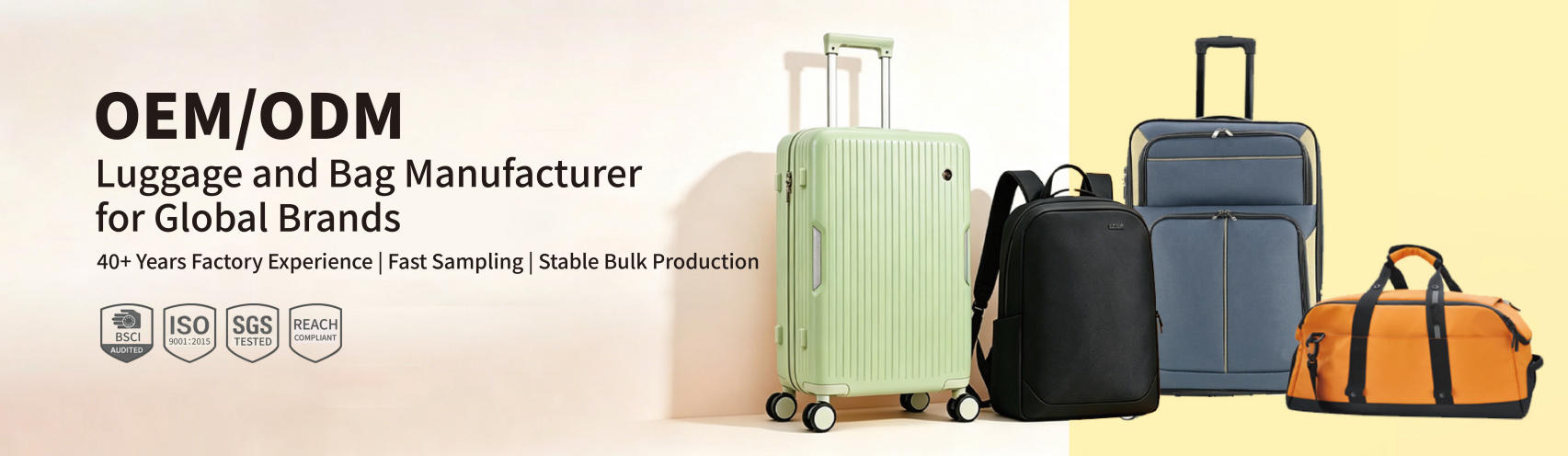
Zabaggo — Zhongan TikTech (Anhui) Co., Ltd. — is the state-owned, specialized luggage and bag export arm of Fortune Global 500 Conch Group. Founded in 1984 with 40+ years of export experience, we provide one-stop OEM/ODM solutions across luggage, backpacks, travel bags, briefcases, sports bags, and children's ride-on cases. With a 30,000 m² self-owned factory, 20 production lines, and 600+ specialists, we ship over USD 600 million annually to 160+ countries and serve 500+ global brand partners under our brands ALIC and AHTECH.
Why buyers choose us: full material coverage — ABS, PC, PP, oxford fabric, and waterproof textiles across hard and soft lines; deep customization of handles, logos, locks, zippers, wheels, linings, colors, shells, fabrics, and internal structure; 7-day sampling and 30-day bulk delivery with flexible MOQ; and complete OEM/ODM, sample-processing, and private-label support.
Supply chain and logistics: mixed-color, mixed-model container loading; domestic warehousing and international multi-modal transport (FCL/LCL sea, rail, and road) covering the Middle East, Africa, Southeast Asia, South America, Europe, and North America — with full export documentation and customs assistance.
From a European travel agency that cut return rates with a TSA-lock upgrade, to a UK luggage brand managed end-to-end from sample to delivery, to a Canadian outdoor brand optimized for extreme climates — our case center shows how we turn a licensing brief into product. Contact our export desk to discuss your next range.
Leave A Message
Scan to Wechat :

Scan to WhatsApp :