Leave A Message
If you are interested in our products and want to know more details,please leave a message here,we will reply you as soon as we can.

When navigating congested international airport hubs, catching tight train transfers, or packing for an extended road trip, the reliability of your baggage directly dictates your travel comfort. As global passenger volume swells and commercial airlines enforce stricter baggage weight limits and handling protocols, deciding between rigid and fabric travel gear has become a vital consideration for frequent travelers.
To evaluate the debate between hard shell and soft luggage, one must first understand how materials science has reshaped travel equipment over the past two decades. Historically, soft luggage dominated baggage carousels worldwide. Early soft bags relied heavily on thick canvas or heavy polyester knits. While forgiving in capacity, these fabrics often absorbed environmental moisture, accumulated highway grime, and provided limited protection against physical crush forces in cargo holds.
The introduction of high-grade thermoplastics radically altered the industry landscape. Modern hardside cases are constructed from materials such as Acrylonitrile Butadiene Styrene (ABS), Polycarbonate (PC), and Polypropylene (PP). Polycarbonate, in particular, offers an exceptional strength-to-weight ratio; it flexes under severe external shock and immediately bounces back without fracturing.
Simultaneously, textile engineering advanced significantly. High-density 1680D ballistic nylon and Cordura fabrics brought tear resistance and hydrophobic coatings to soft-sided gear. Consequently, evaluating hardshell vs softshell luggage requires looking beyond mere appearances to analyze structural physics, weight distribution, and environmental resilience.
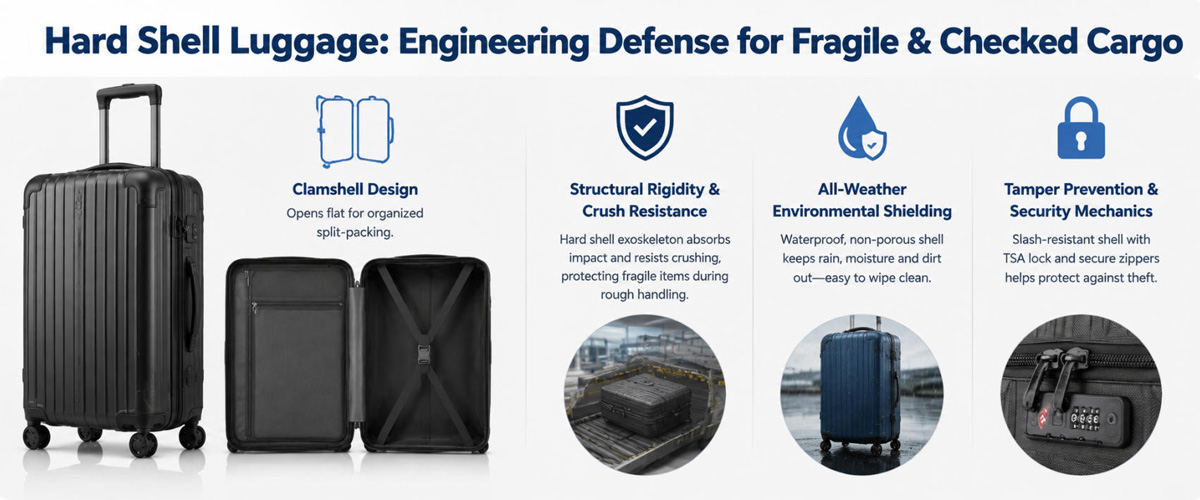
Hard shell suitcases are structurally built on a dual-compartment "clamshell" architectural framework. The two halves open flat on a central hinge, creating an interior split-packing system.
Structural Rigidity & Crush Resistance
The definitive advantage of rigid luggage lies in its ability to withstand multi-directional kinetic impact. During international baggage handling, bags are routinely subjected to automated sorting ramps, drop chutes, and high-density stacking in cargo holds where hundreds of pounds of pressure bear down on individual units. A hard shell acts as a structural exoskeleton, absorbing kinetic energy along its outer perimeter rather than transferring forces directly into packed contents. For travelers carrying delicate electronics, DSLR camera bodies, cosmetic bottles, or structured tailoring, this exoskeleton design provides superior peace of mind.
All-Weather Environmental Shielding
Tarmacs in monsoon rains, icy sidewalks, and damp cargo bays expose luggage to harsh environmental conditions. Thermoplastic outer shells are intrinsically non-porous and water-impermeable. Water glides off the smooth surface without soaking into garments. Cleaning requires nothing more than a swift wipe down with a damp microfiber cloth, maintaining hygiene across multiple trips.
Tamper Prevention and Security Mechanics
Fabric bags can be vulnerable to opportunistic punctures or sharp blades. In contrast, solid polymer shells present an impenetrable barrier against slashes and tears. When paired with integrated TSA-approved 3-digit combination locks and puncture-resistant double-coil zippers or frame-lock latches, hard shell luggage offers substantial security against unauthorized access.
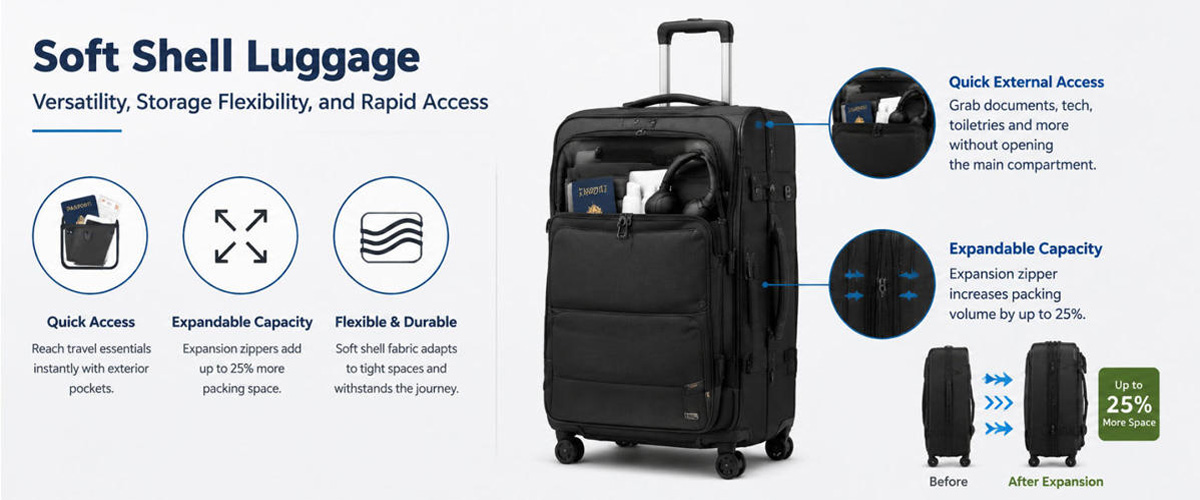
Despite the market surge of hardside cases, high-performance soft shell luggage continues to serve a dedicated global demographic of business travelers, digital nomads, and overland adventurers who value quick external storage and adaptive packing volume.
Exterior Accessibility and Front Pocket Utility
The major operational drawback of traditional clamshell hard cases is that accessing an item requires laying the bag flat and unzipping it completely. Conversely, a luggage soft shell design features strategically placed exterior pockets. Travelers can instantly reach travel documents, tablets, noise-canceling headphones, or liquid toiletries at airport security checkpoints without exposing their personal items to public view.
Volumetric Compression and Spatial Adaptability
High-tensile woven nylon fabrics possess structural elasticity under stress. When squeezing into tightly packed overhead compartments on regional aircraft, crowded train luggage racks, or compact vehicle trunks, soft bags yield slightly under pressure where a rigid case would collide with overhead limits. Furthermore, built-in expansion zippers allow softside suitcases to increase internal volume by up to 25%, accommodating unexpected souvenirs or winter garments.
| Technical Metric | Hard Shell Suitcases | Soft Shell Suitcases |
| Core Materials | Polycarbonate (PC), ABS, Polypropylene, Aluminum | 1680D Ballistic Nylon, Cordura, High-Density Polyester |
| Structural Integrity | High rigidity; absorbs and distributes impact forces | Flexible shell; relies on packed clothes for internal support |
| Water Repellency | Impermeable thermoplastic shell surface | Water-resistant coating; vulnerable under severe downpours |
| Storage Mechanics | 50/50 dual-cavity clamshell layout | Deep single main cavity + multi-tier exterior pockets |
| Flexibility & Fit | Fixed external dimensions | Compressible profile with high expansion capacity |
| Weight Profile | Featherweight in modern PC/ABS blends | Lightweight, though multi-pocket zippers add slight weight |
When weighing hard shell luggage vs soft options, match your decision to your typical travel habits:
Whether your travel style calls for the impervious shield of a high-impact hardside spinner or the adaptable flexibility of a lightweight softside carry-on, ultimate reliability depends on manufacturing excellence and dependable customer support. At Zabaggo (www.zabaggo.com), we bridge the gap between luxury engineering, user-focused functional design, and direct-to-consumer value.
Every piece of Zabaggo gear undergoes rigorous lab testing—including multi-angle drop tests, telescopic handle pull-stress cycles, and high-mileage wheel tread assessments. Our hardside collections feature ultra-tough ABS/PC polymer blends and scratch-resistant finishes, while our softside series utilizes high-density water-resistant fabrics with reinforced corner bumpers. All models are equipped with smooth 360° whisper-quiet dual spinner wheels, heavy-duty anti-burst YKK zippers, and built-in TSA-approved combination locks.
Beyond superior product quality, Zabaggo provides an exceptional service experience:
Invest in gear that works as hard as you do. Browse our latest arrivals, explore our specialized Hardside Luggage and Softside Luggage collections today at www.zabaggo.com, and travel the world with complete confidence.
Leave A Message
Scan to Wechat :

Scan to WhatsApp :