

The Engineering Behind Durable Luggage: A Factory Guide to OEM/ODM Quality Control
Every year, luggage brands lose millions of dollars to quiet, costly line items: high return rates, negative Amazon reviews, brand erosion, and warranty payouts. On a retail shelf, a $40 budget suitcase and a $300 premium model can look virtually identical. But put both through 50 commercial flight cycles, and the difference is stark: one develops brittle shell fractures, loose wheel axles, and split zipper tracks, while the other remains structurally flawless.
For global importers, brand managers, and sourcing executives, the line between healthy profit margins and brand destruction often comes down to factory-level engineering choices.
What actually elevates a suitcase from a fragile promotional item to a high-reliability commercial product?
From resin formulation and component tolerances to dynamic stress distribution and lab testing, this technical guide reveals what really happens inside a world-class luggage manufacturing facility—and how you can evaluate OEM/ODM partners with precision.
1. Polymer Chemistry & Material Performance Metrics
The foundational integrity of any suitcase depends heavily on the chemical purity and physical properties of its raw materials. High-end factories do not merely select materials by broad category (e.g., "Polycarbonate"); they specify grade, melt flow rate, and molecular weight distribution.
Hardshell Material Performance Comparison
In hardshell evaluation, materials are benchmarked across critical mechanical thresholds:
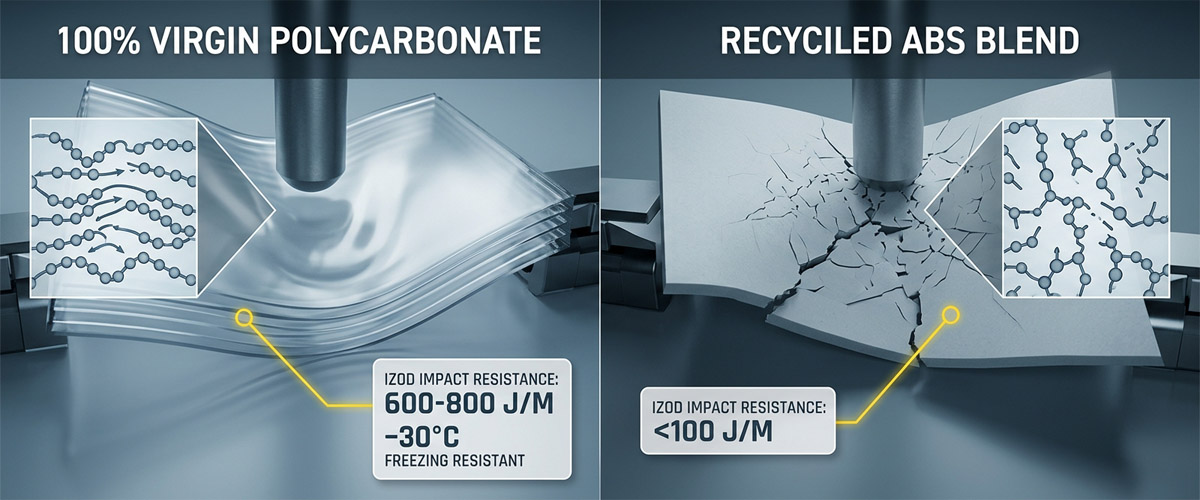
- 100% Virgin Polycarbonate (PC): Exhibits a Tensile Yield Strength (ASTM D638) of 60–70 MPa and an Izod Impact Resistance (ASTM D256 at -30°C) of 600–800 J/m. Pure aerospace-grade PC features long polymer chains that flex under dynamic load and rebound to their original shape via elastic memory.
- PC/ABS Alloy: Offers a Tensile Yield Strength of 45–55 MPa and an Izod Impact Resistance of 200–350 J/m, providing moderate impact resistance at a mid-tier price point.
- 100% ABS: Features a Tensile Yield Strength of 30–40 MPa and an Izod Impact Resistance of under 100 J/m. ABS exhibits brittle fracture behavior under sub-zero impact, making it susceptible to cracking in cold cargo bays.
The Cost-Cutting Trap (PC/ABS & Regrind): To lower BOM (Bill of Materials) costs, lower-end factories often extrude 3-layer co-extruded sheets using a thin virgin PC top film over recycled ABS or PC scrap cores. While rigid, these composite sheets exhibit poor fatigue resistance and develop micro-fissures around thermoformed corner stress points.
To compare structural rigidity and resin specs against production baselines, review the ABS hardside luggage set.
Textile Engineering: Denier, Weave, and Coating Technology
In softside bag construction, fabric performance is determined by yarn tenacity and back-coating chemistry:
- High-Tenacity 1680D Ballistic Nylon: Formed with multi-filament twisted nylon 6,6 yarns, this fabric exhibits a tear strength exceeding 250 N (ISO 13937).
- Hydrostatic Pressure & Backing: High-grade luggage fabrics feature multi-pass Polyurethane (PU) or Polyvinyl Chloride (PVC) backings, achieving a hydrostatic head rating of >2000 mm to prevent moisture ingress through seam perforations.
2. Mechanical Engineering & Hardware Tolerances
Over 85% of warranty claims stem from mechanical dynamic component failures—specifically telescoping handles, wheel assemblies, and main entry closures.
Precision Trolley Architecture & Clearance Engineering
A premium telescoping system relies on precise wall-thickness specification and tight assembly tolerances:
- Tubing Specification & Wall Thickness: High-grade trolley systems utilize 6063-T5 anodized aluminum tubing with a structural wall thickness of 1.0 mm to 1.2 mm to withstand bending forces.
- Dampening Systems & Clearance Control: To eliminate handle sway and rattle, quality factories limit tube-in-tube radial clearance to under 0.15 mm. Custom Polyoxymethylene (POM) inner sleeve dampeners and internal spring actuators ensure fluid extension without mechanical wobble.
Spinner Wheel Assemblies: Kinematics and Bearing Seals
- Bearing Kinematics: Low-grade wheels use plastic plain bushings that generate friction heat and seize under load. High-performance caster assemblies feature ABEC-5 rated sealed stainless steel dual ball bearings, ensuring 360-degree rotation under continuous loads up to 30 kg per wheel.
- Tread Compound (Durometer Rating): Treads are over-molded using Thermo-Plastic Elastomer (TPE) or Polyurethane (TPU) with a Shore A hardness rating of 65A to 75A, providing an optimal balance of shock absorption, noise reduction (<50 dB), and high resistance to wear.
To examine how precise wheel alignment and trolley mechanics come together in a production-ready model, see the 20/24/28-inch travel luggage with spinner wheels.
Zipper Track Integrity: Puncture and Lateral Burst Strength
- Burst Strength (ASTM D2061): Standard #8 or #10 metal/coil zippers must withstand a lateral chain cross-wise burst force exceeding 800 N.
- Explosion-Proof Interlocking Coils: Double-layer zipper tracks feature reverse-interlocking teeth that resist puncture forces exceeding 150 N, preventing forced entry via sharp objects.
3. Interior Structural Detailing & Precision Assembly
Precision assembly inside the suitcase protects packed contents and reinforces exterior seams.
| Technical Parameter | Standard Luggage | Advanced OEM/ODM Production |
| Lining Specification | Loose 190T Polyester (Raw edges) | Tailored 210D/300D Oxford/Peach-skin (PU coated) |
| Seam Construction | Single-stitched, 3-4 SPI | Double-needle lockstitch, 6-8 SPI with bound edges |
| Thread Type | Spun Polyester | Continuous Filament Bonded Nylon 6,6 (Tex 70) |
| Load Distribution | Directly glued to shell | Riveted load-bearing internal reinforcement plates |
Stitching Pitch & Tension: Sewing pitch is calibrated strictly to 6–8 Stitches Per Inch (SPI). Lower SPI results in seam separation under load, while higher SPI (>10 SPI) over-perforates the shell wall or lining, creating stress points.
4. Laboratory Stress Testing & Compliance Standards
Before entering mass production, pre-production samples (PPS) pass through a multi-stage factory quality control testing pipeline under standardized lab conditions (such as ISO, QB/T 2155, and ASTM protocols):
- Environmental Freezing & Drop Test (QB/T 2155 / ISO 22770): Packed to a maximum capacity weight of 20–25 kg, the luggage is conditioned in a freezing chamber at -12°C for 4 hours. It is then repeatedly dropped from a height of 1.5 to 3.0 meters onto concrete across 8 distinct impact angles, testing structural corner integrity and wheel-mount fatigue.
- Pneumatic Handle Jerk Test: An automated pneumatic arm jerks the fully extended handle up and down under load for 5,000 to 10,000 continuous cycles to evaluate rivet shear, locking-pin engagement, and handle deflection.
- Continuous Conveyor Mileage Test: Loaded bags are dragged over an uneven motorized conveyor surface embedded with obstacle bars at 4.5 km/h for 50 kilometers to assess tread wear and housing deformation.
- Zipper Abrasion & Reciprocating Test: Zipper assemblies are cycled continuously for 15,000 openings and closings under tension to verify slider durability and tooth retention.
- Corrosion Resistance (ASTM B117): Metal hardware, sliders, and aluminum frames undergo a 5% neutral salt-spray chamber test for 48 to 72 hours to ensure zero surface pitting or oxidation.
5. Quality Management Systems & Responsible Manufacturing
Modern production facilities complement mechanical capability with rigorous quality controls and environmental compliance.
- Statistical Process Control (SPC): Utilizing AQL (Acceptable Quality Limit) 1.5/2.5 inspection protocols across incoming material receiving (IQC), in-line assembly (IPQC), and final pre-shipment auditing (OQC).
- Chemical Compliance: Material screening ensures raw polymers and hardware plating pass REACH (SVHC), California Proposition 65, and RoHS chemical safety standards.
- Factory Certifications: Operating under ISO 9001 (Quality Management) and ISO 14001 (Environmental Management), along with third-party social compliance audits (BSCI, SMETA).
Partnering with Zabaggo: Precision Manufacturing at Scale
Building luggage that withstands global distribution requires an OEM/ODM partner with deep technical knowledge and stable supply chains. At Zabaggo, we transform technical specifications into durable, mass-produced luggage.
Our integrated manufacturing services offer:
- Material Verification: Full traceability for virgin PC, high-grade aluminum alloys, and GRS-certified recycled fabrics.
- Custom R&D and Prototyping: Rapid 3D mold development, structural finite element analysis (FEA), and mechanical prototyping.
- In-House Testing Lab: On-site drop, jerk, and mileage testing to verify performance prior to production.
- Ethical, Audited Facilities: ISO 9001 quality compliance and BSCI-certified manufacturing to protect your brand's integrity.
Discover how our engineering capabilities can strengthen your product line. Visit Zabaggo.com to review our custom manufacturing solutions or speak directly with our engineering team.