

EU GPSR & REACH Compliance for Bags & Luggage (2026)
For importers, wholesalers, and private-label brands, the rules changed quietly in late 2024 — and the effects are now showing up in real order books. Every bag, suitcase, and travel accessory sold in the European Union is now treated as a regulated consumer product with a paper trail. For B2B buyers sourcing from a luggage manufacturer in Asia, that means one thing: the supplier's compliance file now matters as much as the unit price.
Why the EU suddenly matters for bags
Small and mid-size brands have been vocal about the cost of the EU's newest regulation, and the frustration is understandable. Compliance is no longer a stamp on an export invoice — it is a condition of entry. For luggage wholesale suppliers and importers, it is also an opportunity: the factories that can hand over a complete, correct document pack are now winning orders that price-led factories lose.
Three frameworks cover nearly everything a bags importer will face:
- GPSR — the General Product Safety Regulation
- REACH — chemical substance restrictions
- BSCI — social compliance audits
GPSR: the new baseline for every consumer product
The EU General Product Safety Regulation (GPSR) has applied since 13 December 2024 to all consumer products placed on the EU market — including luggage, handbags, and travel accessories. It replaces the older General Product Safety Directive and, critically, closes the gaps that online and direct-to-consumer imports used to slip through.
What it means for a bags importer:
- An economic operator (manufacturer, importer, or authorised representative) must be identifiable on the product, packaging, or accompanying document, with a name and contact address inside the EU.
- Products must carry traceability data — type, batch or serial number, and the manufacturer's details where relevant.
- Safety instructions and warnings must be provided in the language of the member state where the product is sold.
- Importers must keep technical documentation proving the product is safe, and produce it to authorities on request.
In practice, this pushes responsibility up the chain. If you are the EU-based importer of record, the burden is yours — which is exactly why the factory you buy from must be able to produce the underlying documentation on demand.
REACH: the chemical rules that catch bags off guard
REACH predates GPSR but dovetails with it. For luggage, the relevant risk is rarely the shell material itself — it is the things you cannot see: phthalates in soft PVC trims, azo dyes in textile linings and straps, and restricted substances in adhesives, coatings, and hardware finishes.
Buyers often learn this the hard way at the port, when a random inspection flags a lining or a handle grip. The practical defence is a supplier who can provide:
- Material test reports against the relevant REACH annexes
- Restricted substance declarations for each material component
- Batch-level traceability linking the tested sample to the production run
For a private label luggage manufacturer, saying "we use compliant materials" is not enough. The paperwork has to name the substance, the test method, and the result.
BSCI: the social licence to operate
BSCI (Business Social Compliance Initiative, run by amfori) is not a legal requirement in the way GPSR and REACH are, but it has become a de facto buying requirement for many EU retailers and corporate buyers. A BSCI audit covers labour conditions, working hours, health and safety, and environmental basics at the production site.
For importers supplying department stores, retail chains, or corporate gift programmes, a current BSCI report is often the difference between a shortlist and a rejection — as are the factory's ISO quality systems and any audit trail an EU buyer's compliance team can verify quickly.
What to actually ask your supplier (the 2026 checklist)
Rather than asking "is your luggage compliant?" — which produces an unverifiable "yes" — importers should request a specific document pack. A compliance-ready luggage OEM supplier should be able to return this within days, not weeks:
- GPSR file — EU responsible-person details, product traceability format, and multilingual safety/warning text for the target member states.
- REACH material declarations — per-component test reports and restricted-substance statements.
- BSCI or equivalent audit report — current and covering the producing facility.
- Batch traceability — the link between the tested sample, the raw material lot, and the production run you are buying.
- Third-party test-house credentials — lab reports from recognised bodies, not in-house declarations.
The trend is now unmistakable: rising compliance costs are squeezing low-margin suppliers out of the EU channel, while buyers consolidate around factories that produce the paperwork as reliably as the product. If a supplier stalls on point two or three, treat it as a red flag — the real problem is usually upstream, in a material source they cannot document.
Frequently Asked Questions
Is a REACH certificate enough to sell bags in the EU?
No single certificate covers EU entry. REACH addresses chemicals; GPSR addresses general product safety, traceability, and labelling; and many retail buyers separately require a BSCI or equivalent social audit. A reliable luggage OEM supplier should be able to supply all three document sets together rather than treating any one as sufficient.
How do I check whether a luggage factory is genuinely BSCI certified?
Ask for the report number and the auditing body, then verify it against the amfori BSCI public platform or request the latest audit report showing the production facility's address. Cross-check that the audited site matches the factory actually producing your order.
What is a realistic timeline for samples and bulk production with compliant materials?
Compliance should not slow you down if the supplier has done the work up front. A well-prepared travel luggage manufacturer can typically deliver samples in around seven days and bulk production in roughly thirty days, provided the selected materials already hold current test reports. Custom material changes may extend the timeline for re-testing.
What export documents do I need beyond product compliance?
Alongside the GPSR and REACH documentation, expect a commercial invoice, packing list, bill of lading, certificate of origin where needed, and any buyer-specific forms. A full-service export desk should assemble these so clearance is not delayed at the destination port.
Where can I find a supplier that already keeps this compliance file ready?
The fastest path is to shortlist factories that market compliance as a capability rather than an afterthought — those with current BSCI reports, REACH-tested material lines, and a GPSR-ready document template. See the box below for a supplier that keeps this pack on file.
About the Sponsor — Zabaggo (Zhongan TikTech (Anhui) Co., Ltd.)
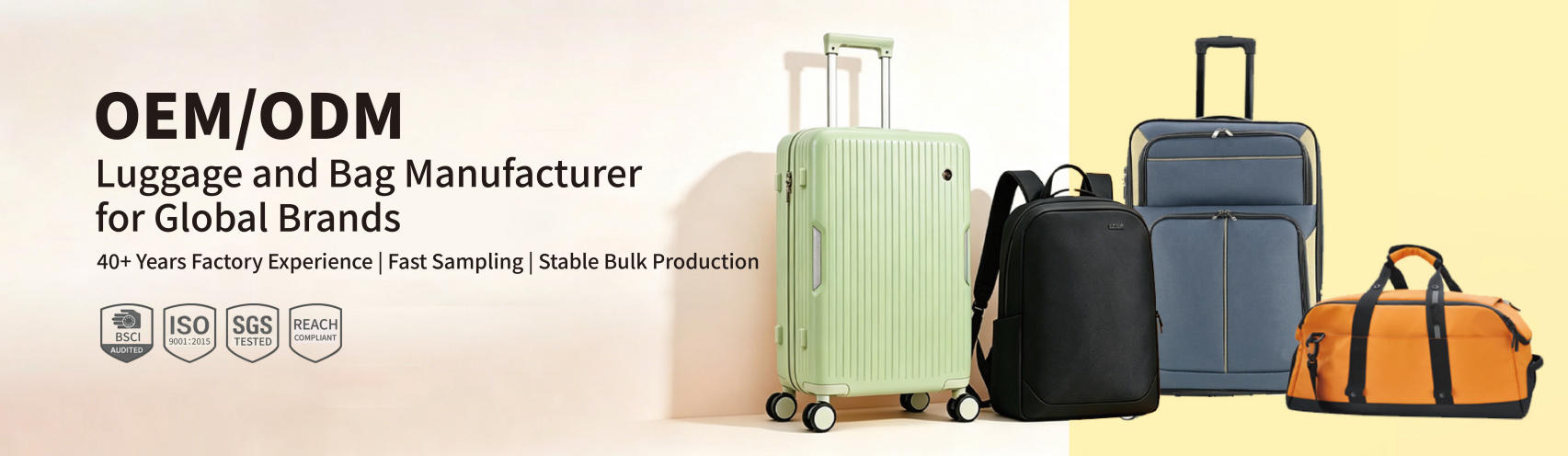
Owned by a Fortune Global 500 group, Anhui Conch Group, Zabaggo is a state-owned professional luggage and bags export company with more than 40 years of trade experience, founded in 1984. We offer one-stop OEM/ODM export solutions across luggage, backpacks, travel bags, business bags, sports bags, and kids' ride-on cases — including our in-house brands ALIC and AHTECH.
- Full material coverage: ABS, PC, PP, and Oxford fabrics — hard and soft cases alike — plus waterproof textiles.
- Deep customisation: handles, logos, locks, zippers, wheels, linings, colours, shells, fabrics and internal structure can all be tailored.
- Fast turnaround: 7-day sampling, 30-day bulk delivery, with flexible MOQs for every buyer profile.
- Scale that backs it up: 30,000 m² self-operated factory, 20 production lines, 600+ specialist staff, over US$600 million annual turnover, products shipped to 160+ countries and regions, and 500+ global brand partners.
Real projects from our case centre:
- A European travel agency ordered custom-branded luggage in bulk, with a TSA lock upgrade that reduced post-sale return rates.
- A UK luggage brand partnered with us for full-series OEM manufacturing, from sampling through to bulk delivery.
- A Canadian outdoor brand ordered waterproof backpacks, with material optimisation and ergonomic design for extreme climates.
Supply chain & logistics: mixed-style, mixed-colour consolidated container loading; domestic warehousing and short-haul transport; international multimodal shipping (FCL/LCL sea freight, rail, road) covering the Middle East, Africa, Southeast Asia, South America, Europe and North America; plus complete export documentation and customs clearance support.
Ready to clear EU customs without the compliance headache? Inquire for OEM order for a GPSR/REACH/BSCI-ready quote — sampling in 7 days, bulk delivery in 30.