
Luggage Industry Trends 2026: What is Shaping the Future of Global Travel Gear?
The global travel and luggage ecosystem is undergoing a fundamental structural transition. As international passenger traffic stabilizes at historic highs across major hubs in Europe, North America, and East Asia, consumer behavior is decoupling from traditional volume-based purchasing. Driven by evolving airline baggage tariffs, remote-work mobility, and macroeconomic pressures, the modern traveler evaluates travel gear not merely as a storage container, but as a critical piece of functional performance equipment.
According to recent coverage across luggage industry news channels, the market in 2026 demands a sophisticated balance between material longevity, mechanical efficiency, modular adaptation, and verified ESG (Environmental, Social, and Governance) compliance. For luggage brand managers, retail buyers, and global supply chain directors, navigating these developments requires moving past surface-level aesthetics into the material engineering, mechanical design, and manufacturing economics shaping the industry's next decade.
1. Macro Economic & Behavioral Drivers: The Dual Dynamics of 2026 Travel
To understand current product innovation, brands must first analyze the structural forces altering how travel gear is used and stressed in the field:
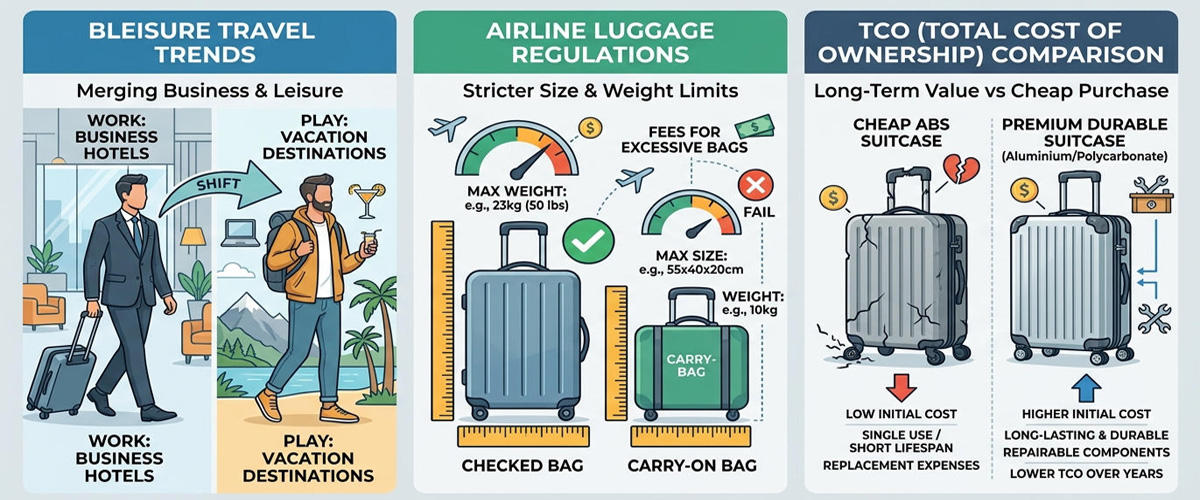
- The Premium Micro-Break & Bleisure Hybridization: The traditional boundary between business travel and leisure vacation has largely dissolved. Corporate travelers frequently extend work trips into remote work stays, necessitating luggage that transfers effortlessly from formal executive hotels to rugged outdoor settings without requiring a complete gear swap.
- Strict Airline Overhead & Weight Enforcement: Tier-1 international carriers and regional low-cost airlines have tightened gate-side dimensional enforcement and weight allowances. This shift forces manufacturers to optimize the structural strength-to-weight ratio of every component—from shell wall thickness to trolley tube profiles.
- The Total Cost of Ownership (TCO) Shift: Consumer frustration with cheap ABS shells cracking after single-digit flights has created a decisive market pivot. Buyers increasingly view travel gear through a TCO lens, willing to pay a premium for repairable, impact-tested hardware over short-lived disposable items.
2. Material Science Evolution: Advanced Shell Metallurgy & Composite Engineering
Material selection defines both product lifespan and brand positioning. In 2026, the industry is marked by sharp technical divergence across hardshell materials.
A. Premium Metallurgy: The Dominance of the Aluminum Carry-On
In the high-end executive and corporate sectors, thermoplastic shells are increasingly replaced by high-grade alloy construction. The market expansion of the engineered aluminium carry on stems directly from its mechanical superiority under extreme shear and compressive stress.
Modern premium aluminum cases utilize 5000-series aluminum-magnesium alloys (such as 5052-H32), cold-formed under heavy hydraulic pressing to achieve optimal structural rigidity. Unlike plastic polymers that degrade under UV exposure and micro-fracture under cold-climate baggage handling, aluminum maintains structural integrity across extreme temperature spectrums (-40°C to +80°C). Furthermore, zipperless designs utilizing deep-drawn aluminum frames with integrated rubber sealing gaskets offer IP54-level dust and splash resistance, protecting high-value electronics from environmental exposure.
B. Polymer Comparisons in Modern Hardshell Design
- ABS (Acrylonitrile Butadiene Styrene): Low cost and rigid, but brittle under cold temperatures and prone to impact cracking under heavy stress.
- Polypropylene (PP): Exceptional fatigue resistance and low density, but prone to surface scratching and high thermal expansion.
- Polycarbonate (PC): High impact strength and elasticity, performing exceptionally well under stress, but requires precise virgin-resin formulations to avoid micro-crazing.
- Al-Mg Alloy: Superior tensile strength, zero UV degradation, complete recyclability, and absolute frame rigidity under severe impact loads.
3. Mechanical Architecture: Two-Wheel vs. Four-Wheel Engineering in Real-World Transit
A central debate within modern luggage development revolves around caster configuration. While four-wheel 360-degree spinner wheels dominate smooth indoor airport terminals, their mechanical vulnerabilities become glaringly evident on uneven outdoor terrain.
This technical reality has driven a strong commercial revival of the heavy-duty two wheel carry on luggage. The engineering advantages of two-wheel architecture are rooted in mechanical physics:
- Impact Absorption & Wheel Diameter: Two-wheel configurations utilize larger-diameter (70mm–90mm) polyurethane (PU) wheels mounted on sealed stainless steel ball bearings. This larger rolling radius allows the luggage to roll smoothly over cobblestones, expansion joints, and curbs without catching or transferring high-frequency vibrations to the user's arm.
- Internal Volume Optimization: Four-wheel spinners require recessed corner housing boxes that encroach directly into the internal packing cavity, reducing usable volume by up to 12%. Embedded two-wheel housings sit low within the chassis, preserving critical internal packing depth while keeping overall external dimensions within strict airline sizing templates.
- Mechanical Load Defense: Multi-directional spinner stalks act as lever arms during luggage drops; impact forces concentrate on small mounting points, often shearing the wheel housing off the shell. In contrast, two-wheel housings distribute impact forces horizontally across a wider structural chassis plate.
4. Functional Modular Mobility: The Rise of the Suitcase Backpack Set
As travel itineraries become more fluid, single-unit luggage often creates operational friction. The modern solution lies in modular gear ecosystems, exemplified by the coordinated suitcase backpack set.
This system pairs a structured rolling carry-on with a specialized, ergonomically balanced travel backpack. Rather than relying on secondary strap attachments that sag or swing while walking, advanced sets feature dedicated pass-through sleeve panels, magnetic quick-lock fidlocks, or integrated rail-track docking systems. This allows a traveler to move through transit hubs with a consolidated single center of gravity, and then instantly detach the backpack for use as a standalone mobile office or daypack upon arrival at their destination.
5. Supply Chain Strategy: Why Partnering with a Specialized Luggage Factory in China Drives Commercial Advantage
Translating these complex material and mechanical specifications into scalable, cost-competitive retail products requires a deeply integrated manufacturing base. Sourcing directly from an experienced luggage factory china remains the primary strategy for international brands seeking to balance production speed, precision tooling, and material sourcing.
China's luggage manufacturing ecosystem provides unparalleled supply chain density. Within concentrated industrial clusters, factories maintain immediate access to specialized aluminum extrusion mills, precision injection molding facilities, customized hardware stamping shops, and certified testing labs. This proximity drastically reduces prototyping turnaround times and enables complex engineering integrations—such as recessed wide-trolley aluminum handles and TSA-cleared custom latch mechanisms—that would be cost-prohibitive in fragmented supply chains.
Manufacturing Excellence & B2B Partner Services: The Zabaggo Advantage
At Zabaggo, we serve as the manufacturing engine behind leading international travel gear brands, corporate procurement programs, and retail chains. Backed by over 40 years of continuous OEM and ODM production experience, our manufacturing operations combine deep technical heritage with modern industrial precision.
40+ Years of Precision OEM/ODM Engineering: Decades of specialized production have allowed us to refine every phase of luggage construction. From hydraulic deep-drawing of aluminum shells to precision-stitched high-denier ballistic nylon backpacks, our technical expertise eliminates costly design flaws before mass production begins.
In-House Tooling & Rapid Prototyping Capabilities: We operate dedicated mold-making and rapid prototyping facilities, allowing custom luggage concepts, proprietary wheel housings, and bespoke handle assemblies to transition from 3D CAD models to functional physical samples in record time.
Rigorous Quality Assurance & Physical Testing Protocols: Every product line manufactured in our facility undergoes strict physical laboratory validation. Our testing battery includes 30kg drop testing under freezing conditions, 5,000-cycle trolley handle jerk tests, continuous 32km wheel tread abrasion trials, and zipper fatigue testing under tensile load.
Scalable Production & Accessible MOQ Structures: We cater to both global enterprise volumes and growing boutique brands. With flexible baseline Minimum Order Quantities (starting at 500 units for fully customized lines) and robust supply chain integration, we help brands scale efficiently without over-extending inventory capital.
Navigating the global travel gear landscape in 2026 requires a manufacturing partner who understands material physics, ergonomic engineering, and market dynamics. Whether you are developing a flagship aluminum carry-on line, engineering a rugged two-wheel travel series, or launching a modular luggage set, Zabaggo delivers unmatched technical precision and factory-direct efficiency. Contact our engineering team today to request custom sample development and B2B pricing catalogs.