
The Karakoram Test: Why Field Conditions Separate Real Design From Marketing
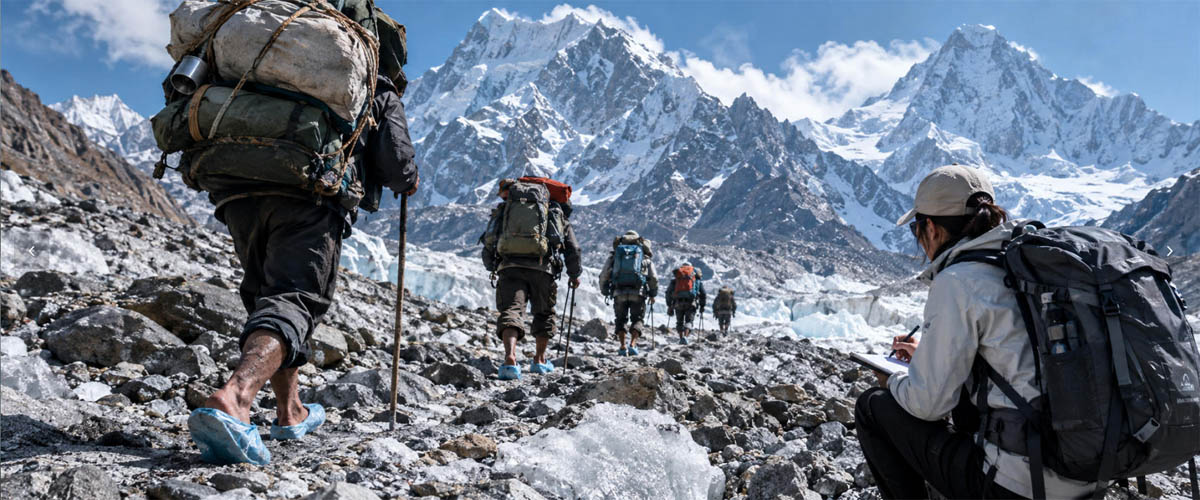
The road to the Karakoram is deliberately hard. A flight to Islamabad, a smaller plane into Skardu, a ten-hour drive over crumbling roads — and then a full week on foot, 120 kilometres across the Baltoro Glacier, before the peaks that pull climbers toward them even come into view. When Neža Peterca, founder of the design studio What Happened, reached base camp, she had crossed two continents and two time zones, and joined a nine-person team documenting Leila Peak and Gasherbrum I for a memorial project.
She was the only woman among roughly forty men — a number that included thirty-seven local porters who carried the expedition's entire load on their own backs, in plastic shoes without socks, eating snow for thirst. That detail matters to anyone in the luggage and backpack business. It is a reminder that a backpack is not a fashion object. At altitude, it is survival equipment.
For an OEM/ODM manufacturer, the Karakoram story illustrates something buyers should internalize: extreme-environment testing is what turns a specification sheet into a credible product. A pack that holds its shape after 120 km of glacier travel, that distributes load evenly at 5,000 metres, that survives abrasion against rock and straps, is a pack designed with intent — not assembled from a catalogue of parts.
The Lost Art of Carrying Loads: Old Wisdom Still Shapes Modern Frames
Long before Cordura, aluminum stays and magnetic buckles existed, human beings had already solved one of survival's hardest problems: how to carry heavy loads over impossible terrain. Firewood, water, trade goods, children, salt, hunting equipment — across continents and centuries, the same question kept reappearing: where does the weight sit?
The answers were radically diverse. Some cultures carried from the forehead, others from the hips. Others relied on flexible netting, woven bark, bamboo frames, or nothing more than a single piece of cloth. Japan's furoshiki — a simple wrapping cloth that began as sacred protection for temple objects in the Nara period and evolved into a multi-purpose carry system by the Muromachi period — survives today as a lesson in adaptability. Each traditional solution reflected both the landscape it emerged from and the people who depended on it.
The reason this history still challenges modern assumptions is that the underlying biomechanics have not changed. The human body still wants load transferred to the skeleton, close to the centre of gravity, with breathability and freedom of movement. Modern suspension systems are essentially high-technology descendants of these ancient principles.
Cordura and the Fabric Foundation
A backpack's fabric is where durability is either won or lost. Cordura nylon remains the benchmark in the outdoor segment for a reason: its high tenacity and abrasion resistance let a pack survive years of rock contact, airport handling and daily wear without delaminating or thinning at stress points. But fabric choice is not binary — the right answer depends on the use case:
- Heavy expedition packs benefit from high-denier Cordura or equivalent ballistic fabrics for abrasion zones.
- Travel and urban packs increasingly blend durability with lighter weights, coated fabrics, and water resistance.
- Waterproof outdoor bags demand taped seams and coated materials tested for extreme climate conditions.
A capable OEM/ODM partner should be able to source and advise across the full material spectrum — hard shell and soft shell — rather than push whatever fabric happens to be on the shelf.
Frame Systems: Aluminum Stays and Load Transfer
If fabric is the body, the frame is the skeleton. Aluminum stays — flat bars or shaped rods inserted into the back panel — are what translate a bag full of weight into a comfortable carry. The core engineering challenge is load transfer: moving weight off the shoulders and onto the hips, where the body is built to carry it.
Key decisions in frame design include the stay's material grade and gauge, whether stays are removable for custom fitting, how the hip belt and lumbar pad interface with the frame, and how the frame manages torsional flex when the wearer moves. These are precisely the variables a knowledgeable manufacturer should be able to engineer to a brand's specification, rather than assembling a generic frame into a generic bag.
Ergonomics: From Forehead Straps to Modern Suspension
Traditional forehead-strap carrying and modern load-bearing hip belts share the same goal: align the load with the body's strongest structures. What changed is the degree of adjustment. Contemporary ergonomic systems tune strap angle, back-panel contour, ventilation channels and sternum-strap placement to fit a wider range of body types.
The commercial lesson comes from a quieter signal in the market. When the Meili travel shirt sold out and the follow-up demand — "when can I get one?" — arrived as a persistent chorus, the brand responded by restocking and adding a long-sleeve version. The lesson transfers directly to backpacks: a genuinely functional product, validated by real user need, creates repeat purchase and line extensions. For buyers sourcing OEM/ODM outdoor packs, the question to ask is whether the manufacturer can build a product good enough to earn that second order.
Turning Insight Into Product Differentiation
All of this — extreme testing, material science, frame engineering, ergonomics — converges on one question for importers, brands and retailers: how do you make an outdoor backpack that stands out in a crowded market? The answer is rarely a single feature. It is the disciplined integration of all of them, which is why the manufacturer you choose is as important as the design you bring. A partner that understands load transfer, fabric selection and field conditions can elevate a spec sheet into a product worth its price tag.
FAQ: Outdoor Backpack OEM/ODM
What is the difference between ABS, PC, PP and Cordura in backpacks and luggage?
ABS, PC and PP are rigid materials used primarily in hard-shell luggage and structural backpack components, while Cordura is a high-tenacity nylon fabric used in soft-shell backpacks and travel bags. ABS is impact-resistant and cost-effective; PC is lighter and more flexible with better scratch resistance; PP is extremely lightweight and durable. Cordura dominates the outdoor segment for abrasion resistance. A full-scope manufacturer runs production lines across ABS, PC, PP, Oxford and waterproof fabrics, so brands can match material to use case rather than compromise.
How does the OEM/ODM customization process work, and what is the minimum order quantity?
Typically the process moves from brief and design confirmation to sampling, then bulk production. In a full-service setup, buyers can customize pulls, logos, locks, zippers, wheels, linings, colours, shells, fabrics and internal structure. A factory with in-house tooling can usually deliver samples in around seven days and bulk orders in about thirty days, with flexible MOQs suited to both emerging brands and large chains. Providing samples for manufacturing and full brand-label (private label) service is standard.
What factory certifications should I check before placing a backpack order?
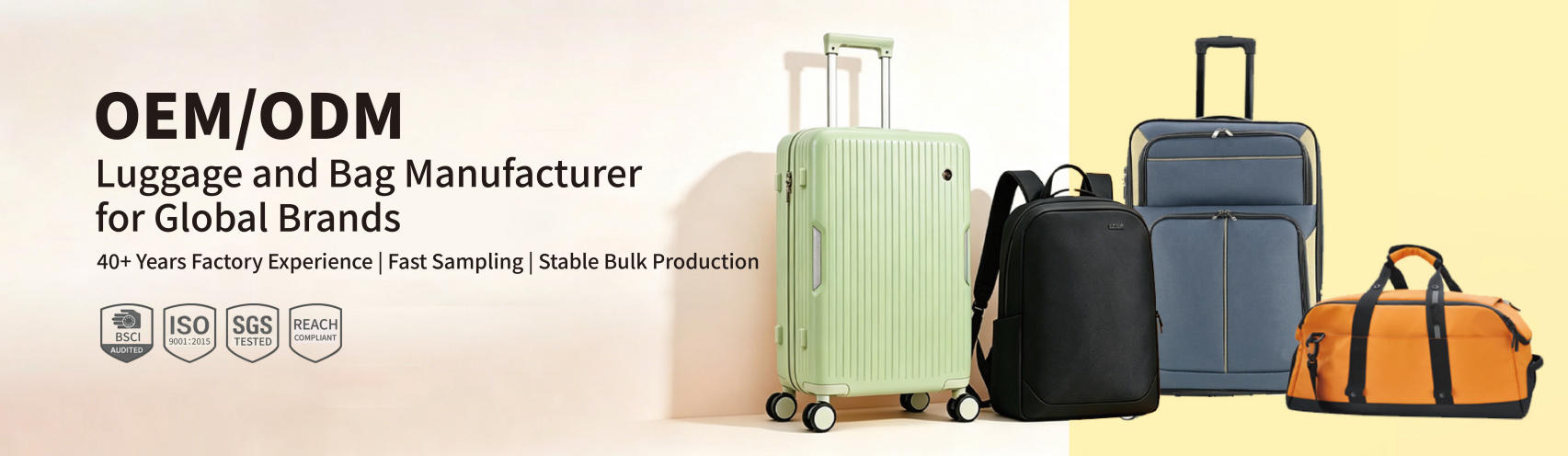
The most relevant include BSCI for social compliance and environmental standards for materials and processes. These matter because overseas buyers increasingly require audited factories before they will place volume orders. A manufacturer with four decades of export experience, serving 500+ brand partners across 160+ countries, should be able to provide certification documents, arrange factory audits and support third-party inspection.
Can I mix styles and colours in one shipment, and how does logistics work?
Yes — many manufacturers support mixed-model, mixed-colour consolidation so buyers can fill a container with multiple SKUs. Typical support includes domestic warehousing and short-haul transport, international multimodal shipping (FCL, LCL, rail and road) covering the Middle East, Africa, Southeast Asia, South America, Europe and North America, plus assistance with export documentation and customs clearance.
What quality-control and testing standards should an outdoor backpack pass?
At minimum, expect material abrasion and tear testing, zipper and buckle cycle testing, seam strength checks, and — for waterproof lines — water-resistance testing. Field-oriented brands often add real-world trial programs. Ask the manufacturer for its QC process, inspection checkpoints and any third-party lab reports before committing to bulk.
How do I start an OEM/ODM backpack project if I only have a rough idea?
Bring your concept, a reference sample, or even just a target market and price point. A capable partner will translate that into material selection, frame and suspension recommendations, and a sampling plan. From there, sampling in about a week and bulk delivery in about a month keeps your launch timeline realistic.
Zabaggo — Your OEM/ODM Backpack & Luggage Export Partner
Zabaggo is the state-owned professional bag and luggage export arm of a Fortune Global 500 group (Zhongan TikTech (Anhui) Co., Ltd.; brands: ALIC, AHTECH). Founded in 1984, we bring 40+ years of export experience to every project.
What we build — full-category OEM/ODM: suitcases, backpacks, travel bags, briefcases, sports bags and kids' ride-on luggage.
Why buyers choose us
- 30,000 m² self-operated factory, 20 production lines, 600+ specialists, 500+ global brand partners, 160+ countries served
- Full material coverage — ABS, PC, PP, Oxford, waterproof fabrics; hard shell and soft shell
- Deep customization — pulls, logos, locks, zippers, wheels, linings, colours, shells, fabrics, internal structure
- Speed — samples in 7 days, bulk in 30 days, flexible MOQ, sample-based and private-label production
- Logistics — mixed-model, mixed-colour consolidated shipping; domestic warehousing; sea (FCL/LCL), rail and road multimodal transport; full export documentation and customs support
Case studies — A European travel agency reduced post-sale returns with a TSA-lock upgrade; a UK bag brand runs full-series OEM from sampling to delivery; a Canadian outdoor brand co-developed waterproof backpacks for extreme climates with ergonomic design.