
What Is the Most Durable Luggage Material? PC vs PP vs ABS vs Aluminum
Choosing the right hard-shell luggage comes down to how a material handles real-world stress. A suitcase on a transit belt faces impact drops, heavy stacking compression, wheel friction, and freezing cargo temperatures—all while staying within strict airline weight limits.
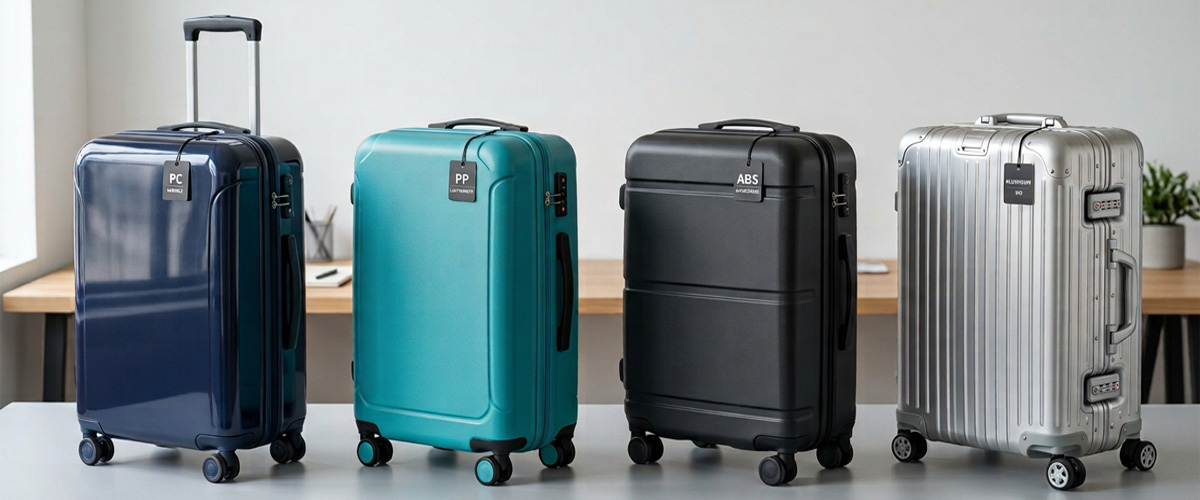
If you are trying to determine the best luggage material for long-term travel, the short answer depends on how you travel. Here is a quick breakdown of how the four main hard-shell materials stack up.
Quick Answer: Material Positioning
- Polycarbonate (PC): Best overall choice for frequent international travel and checked luggage due to high impact resistance and flexibility.
- Polypropylene (PP): Lightest hard-shell material, offering strong crack resistance for strict weight limits.
- ABS: Most budget-friendly option, ideal for occasional travel or entry-level product lines.
- Aluminum: Maximum structural rigidity and premium aesthetic, but prone to denting and significantly heavier.
Material Comparison Matrix
The table below provides a quick side-by-side comparison of the core physical properties and practical applications of each material:
| Material | Impact Resistance | Weight | Flexibility / Memory | Scratch & Cold Resistance | Best Application |
|---|---|---|---|---|---|
| Polycarbonate (PC) | High (Absorbs & recovers) | Light–Medium | High elastic flex | Good cold toughness; scuffs depend on texture | Frequent travel, checked bags, mid-to-high end lines |
| Polypropylene (PP) | Very Good | Very Light (Lowest density) | Very High | High chemical resistance; requires cold-impact modification | Ultra-light carry-ons, weight-restricted flights |
| ABS | Moderate | Light | Lower flex threshold | Hard surface; prone to cracking under extreme force | Budget luggage, promotional sets, low-frequency travel |
| Aluminum | High Frame Rigidity | Heavy | Zero Flex (Dents under force) | Excellent temperature resistance; visible surface patina over time | Luxury business travel, high-end silver suitcases |
What Factors Determine Real Suitcase Durability?
Many buyers assume the hardest material makes the longest-lasting suitcase. In testing, however, absolute hardness can actually make a shell brittle. Practical durability depends on four key factors:
- Energy Absorption: When a loaded bag drops onto concrete, a shell that flexes slightly will absorb and distribute the force. A completely rigid shell transfers that energy directly, increasing the risk of cracking.
- Elastic Recovery: Polycarbonate and modified polypropylene flex under pressure and bounce back to their original shape, preventing permanent collapse under heavy cargo stacks.
- Cold-Temperature Toughness: Aircraft holds often drop below sub-zero temperatures. Materials must maintain impact resistance at low temperatures without becoming brittle.
- Hardware & Frame Design: Shell material is only part of the equation. Spinner wheel housing, corner guards, telescoping handle tubes, and zipper construction directly dictate the bag's lifespan.
Deep Dive: Comparing Hard-Shell Materials
1. Polycarbonate: High Impact Resistance and Balance
When looking at overall polycarbonate suitcase durability, PC remains the preferred standard for checked luggage. Its main mechanical advantage is toughness combined with controlled flexibility. Under sudden impact, a 100% PC shell deforms temporarily rather than fracturing immediately.
While 100% virgin PC resins yield the highest durability, high-grade PC/ABS alloy blends are also common in commercial production. A well-proportioned PC/ABS composite delivers good surface hardness and cost efficiency for general travel collections.
2. Polypropylene vs Polycarbonate
When comparing polypropylene vs polycarbonate, the choice usually comes down to weight versus rigid strength. Polypropylene (PP) has a lower resin density, making it the lightest thermoplastic option for hard-shell manufacturing. It features high hinge fatigue resistance, making it an excellent choice for lightweight carry-ons. However, PC offers better overall structural rigidity and tensile strength for large, heavy-load checked luggage.
3. ABS Luggage vs Polycarbonate Luggage
The comparison of abs luggage vs polycarbonate luggage is largely about price point and usage frequency. ABS is lightweight and inexpensive to process, making it suitable for casual travel. However, pure ABS lacks the elastic recovery of PC. Under heavy impact—especially in cold conditions—an ABS shell is more prone to cracking under stress compared to PC.
4. Aluminum & Metallic Finish Shells
Aluminum luggage replaces zipper closures with heavy-duty frames, corner rivets, and dual latch locks. It provides total crush resistance and a classic luxury look. Aluminum does not flex; high-impact forces result in dents rather than cracks. Many travelers choose aluminum or metallic-coated silver suitcases for their executive appeal and long-term patina.
Matching Materials to Travel Scenarios
Which Material Fits Your Needs?
- Long-Haul Checked Bags: Choose Polycarbonate (PC) for impact absorption against rough baggage handling. Check out our detailed guide on ABS vs Polycarbonate Luggage to compare cost and performance.
- Strict Airline Weight Limits: Choose Polypropylene (PP) to keep shell tare weight as low as possible.
- Budget / Occasional Travel: Choose ABS or entry-level PC/ABS sets for cost-effective protection.
- Executive Business Travel: Choose Aluminum or metallic silver suitcases for frame security and premium styling. Learn more in our OEM/ODM Luggage Manufacturing Guide.
Zabaggo Quality Assurance & Testing Standards
At Zabaggo, we evaluate luggage durability through complete product testing rather than resin data sheets alone. Every collection undergoes rigorous laboratory QA before mass production:
- Loaded Drop Testing: Free-fall tests conducted from heights up to 1.5m under cold-room conditions (-12°C) to verify shell impact strength.
- Handle Jerk Testing: Repeated pull-rod fatigue testing over 3,000 cycles with a 25kg internal payload.
- Wheel Mileage Test: Continuous 32km drum-rolling tests under load to measure wheel tread wear and housing stability.
Whether you are developing PC checked bags, lightweight PP carry-ons, or custom luggage lines, choosing the right material and structural components is critical to long-term performance.
Frequently Asked Questions
Q: Is polycarbonate always better than polypropylene?
Not for every situation. Polycarbonate provides higher rigid impact strength, making it ideal for large checked bags. Polypropylene is lighter, making it a great option for carry-on luggage where weight limits are a priority.
Q: Does polypropylene hold up in cold weather?
Standard commercial PP can become brittle in extreme cold. However, quality PP luggage uses cold-impact modified copolymers engineered to maintain flexibility in low temperatures.
Q: Are PC/ABS composite suitcases reliable?
Yes. A high-ratio PC/ABS blend combines the impact absorption of PC with the surface scratch resistance and lower cost of ABS, offering a practical balance for mid-range luggage.
Q: Why does aluminum luggage dent easily?
Aluminum is a malleable metal. Rather than flexing and springing back like thermoplastics, it absorbs impact energy by bending or denting, which gives it a unique worn look over time.