

What Size Luggage Do You Need? (Carry-On Guide)
Packing for an upcoming flight usually begins with a familiar dilemma: Will my suitcase actually fit into the overhead bin, or will I be forced to pay an unexpected gate-check fee?
Navigating airline luggage regulations often feels like solving a puzzle with constantly changing rules. Domestic carriers, international airlines, and ultra-low-cost budget operators each maintain their own specific size limits, weight restrictions, and enforcement standards. Choosing the ideal suitcase size depends heavily on where you are traveling, the duration of your trip, your mode of transportation, and your personal packing style.
This comprehensive guide breaks down standard carry-on dimensions, provides clear instructions on how to measure your bag accurately, compares overhead luggage against checked gear, and explores larger options like the 28-inch suitcase so you can make confident, informed travel decisions.
Understanding Overhead Baggage Limits: What Is Standard?
When shopping for travel gear, you will frequently see suitcases labeled simply as "carry-on." However, airline regulations vary significantly across regions and ticket classes.
For the majority of major United States domestic airlines—including Delta Air Lines, American Airlines, and United Airlines—the maximum standard dimension for a carry-on bag is 22 x 14 x 9 inches (56 x 35 x 23 cm). This total volume is engineered to fit comfortably head-first or side-by-side into standard overhead compartments on narrow-body and wide-body aircraft.
International and Budget Airline Variations
If your itinerary involves overseas flights or regional budget carriers, "standard" takes on a tighter definition:
- U.S. Domestic Major Carriers: 22" x 14" x 9" (56 x 35 x 23 cm). Generally no strict weight limit for domestic routes, provided you can lift the bag into the overhead bin unaided.
- European & Asian International Carriers: Often restrict height to 21.5" x 15" x 8" (55 x 40 x 20 cm) or 20 inches. International airlines also strictly enforce weight allowances, usually ranging between 7 kg (15 lbs) and 10 kg (22 lbs).
- Budget Ultra-Low-Cost Carriers (e.g., Ryanair, Wizz Air, Spirit, Frontier): Basic economy tickets often limit passengers to a single small "personal item" that fits beneath the seat in front of you (typically 18 x 14 x 8 inches). Bringing a full-size carry-on suitcase requires purchasing an upgraded fare or adding a paid carry-on option.
To avoid unexpected fees at the boarding gate, always verify the baggage allowance for every airline operating a leg of your journey, especially when flying on codeshare partner flights.
How to Measure Luggage Size Properly
A common trap for travelers is relying on the dimensions printed on the product tag or retail box. A manufacturer might market a bag as a "20-inch carry-on," but that number usually refers exclusively to the height of the internal fabric or polycarbonate packing shell—ignoring the hardware attached to the exterior.
At the airport, gate agents assess whether your suitcase fits into rigid metal sizer boxes. These sizers measure the complete, overall footprint of the bag. Knowing how to measure luggage size correctly at home ensures that your gear complies with official limits before you step foot in the terminal.
Step-by-Step Guide: How to Measure a Suitcase
To obtain precise dimensions, place your suitcase upright on a flat, hard surface (such as a hardwood floor or tile surface, rather than a soft carpet or bed) and use a flexible measuring tape.
- Measure the Total Height (Bottom to Top): Place your tape measure on the floor and extend it straight up to the highest point of the bag. Crucial rule: Always measure from the ground up, including the wheels (whether spinner or inline) and the retracted top grab handle.
- Measure the Overall Width (Side to Side): Measure across the widest section of the bag. Pay attention to protruding side handles, side feet/studs, or exterior mounting hardware that extends beyond the main body.
- Measure the Depth (Front to Back): Measure from the rear panel to the front panel at the thickest point. If your suitcase features external zippered pockets or an expandable gusset zipper, measure the bag when fully packed and expanded to reflect its real travel shape.
Mastering how to measure a suitcase gives you total confidence when comparing your bag against strict airline dimensional cutoffs.
Checked vs Carry On: Finding the Right Balance for Your Journey
The decision regarding checked vs carry on luggage comes down to trip duration, climate, destination activities, and personal convenience. Understanding the key difference between carry on and checked bag travel helps you optimize your packing strategy for any itinerary.
The Carry-On Advantage
Traveling exclusively with overhead luggage has transformed modern travel culture, particularly for frequent flyers and business professionals.
- Ideal Trip Length: Weekend getaways, 3-to-7-day business trips, or warm-weather vacations.
- Key Benefits:
-
- Time Savings: Bypass long airport check-in lines and skip the baggage claim carousel upon arrival.
-
- Risk Elimination: Keep your valuable electronics, documents, and personal items with you at all times, eliminating the chance of lost or delayed luggage.
-
- Maneuverability: Effortlessly navigate cobblestone streets, train stations, and public transit without hauling heavy gear.
- Key Limitations: You must adhere strictly to liquid regulations (TSA 3-1-1 rule: liquids in containers of 3.4 oz / 100ml or smaller inside a single quart-sized bag) and restrict bulkier items like extra footwear or heavy winter coats.
The Checked Bag Advantage
While traveling light is ideal, certain itineraries naturally demand greater capacity and flexibility.
- Ideal Trip Length: Multi-week international journeys, family vacations, winter ski trips, or formal events requiring multiple outfit changes.
- Key Benefits:
-
- Unrestricted Packing: Pack full-sized toiletries, liquids, sports equipment, and specialized tools without TSA restrictions.
-
- Ample Capacity: Easily store heavy winter apparel, boots, gifts, and souvenirs acquired during your travels.
-
- Hands-Free Terminal Experience: Once checked at the ticket counter, you can stroll through security and terminals without rolling heavy bags.
- Key Limitations: Potential checked bag fees, mandatory waiting times at airport carousels, and the small inherent risk of airline baggage mishandling.
When You Need Maximum Capacity: The 28in Luggage Size
When a standard carry-on or medium checked bag falls short, a 28in luggage size suitcase serves as the workhorse of long-distance travel.
A standard 28-inch checked suitcase typically measures around 28 x 19 x 11 inches (71 x 48 x 28 cm) excluding wheels and handles, with overall travel dimensions reaching approximately 30 x 20 x 12 inches. It offers a generous interior volume of 90 to 110 liters.
Why Choose a 28-Inch Suitcase?
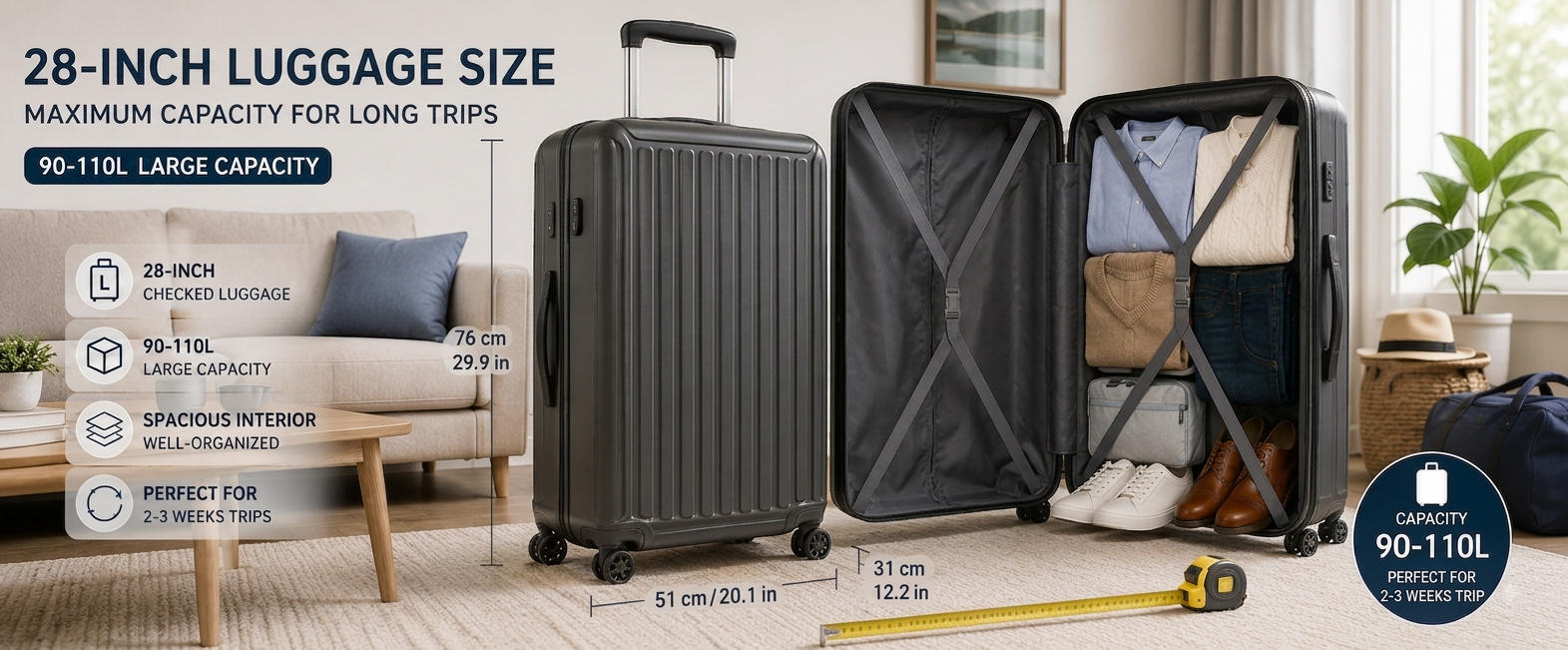
- Linear Dimension Compliance: Most international airlines restrict standard checked bags to a combined total of 62 linear inches (Length + Width + Height). A typical 28-inch spinner calculates to roughly 58 to 60 linear inches, offering maximum storage space while staying safely within standard non-oversized baggage limits.
- Extended Excursions: Perfect for trips lasting two weeks or longer, study abroad programs, seasonal relocations, or cruises where frequent repacking is not required.
- Shared Packing: Excellent for couples or parents traveling with small children who prefer packing belongings into a single large suitcase rather than managing multiple smaller bags.
Pro-tip: When using a 28-inch suitcase, always keep an eye on weight limits. Airlines typically cap standard checked bags at 50 lbs (23 kg). Because a 28-inch bag offers substantial volume, it is easy to exceed weight limits even before filling all available space—a digital luggage scale is a wise investment.
Practical Tips for Efficient Packing
Whether you choose a compact carry-on or a spacious checked trunk, strategic packing maximizes space and protects your belongings:
1. Utilize Compression Packing Cubes: Packing cubes organize garments by category, keep clothes compressed, and prevent items from shifting during transit.
2. Adopt the Rolling Technique: Rolling clothes tight minimizes fabric creases and utilizes tight corners within the suitcase base better than flat folding.
3. Optimize Shoe Placement: Place heavy shoes along the bottom spine of the suitcase (near the wheel base) to maintain balance when standing upright. Fill the insides of shoes with socks or small items to save space.
4. Layer Heavy Gear: Wear your heaviest coat, boots, or sweaters on the plane to free up valuable volume and weight inside your luggage.
Experience Superior Travel Performance with Zabaggo
Choosing the right luggage size is only half the equation—the structural reliability, mobility, and craftsmanship of your bag determine how smoothly your journey unfolds. At Zabaggo, we build premium luggage engineered to withstand the demanding realities of modern global travel.
As a dedicated manufacturer and global luggage brand, Zabaggo blends innovative industrial design with high-grade materials. Every piece in our collection is crafted to deliver seamless performance, whether you are embarking on a quick weekend business trip or an extended international voyage.
Engineering & Material Excellence
Zabaggo suitcases are constructed using durable Bayer polycarbonate hard shells and heavy-duty fabric weaves designed to absorb high impacts while remaining remarkably lightweight. Equipped with smooth 360-degree dual spinner wheels, reinforced corner guards, and ergonomic aluminum telescopic handles, our gear provides effortless maneuverability across airport terminals, train platforms, and city pavements.
Tailored B2B Customization & Manufacturing
Zabaggo is a trusted manufacturing partner for global brands, wholesalers, and corporate clients seeking comprehensive OEM and ODM solutions. We offer complete design flexibility—from custom shell colors and tailored interior organization to bespoke lining fabrics and integrated brand logos. Backed by scalable production capabilities, flexible MOQs, and stringent quality control, we reliably turn custom luggage concepts into market-ready products—on time and within budget.
End-to-End Global Supply Chain
Our integrated supply chain ensures consistent quality assurance at every stage of production, from raw material selection to final drop testing. With efficient global logistics and client-focused service, Zabaggo provides reliable delivery and ongoing support for international partners worldwide.
Ready to elevate your travel experience or expand your product line with high-performance luggage? Explore our complete range of innovative carry-ons and travel gear at Zabaggo, or contact our team directly through our Contact Us page to learn more about wholesale distribution and custom manufacturing services.